Hush

“HUSH - a quiet exploration of the Cowal Peninsula, in textiles”

My 2018 solo exhibition.

Immersing myself in a specific geographical location for extended periods of time. Observing, re-interpreting and communicating how I see colour and shape in the landscape.

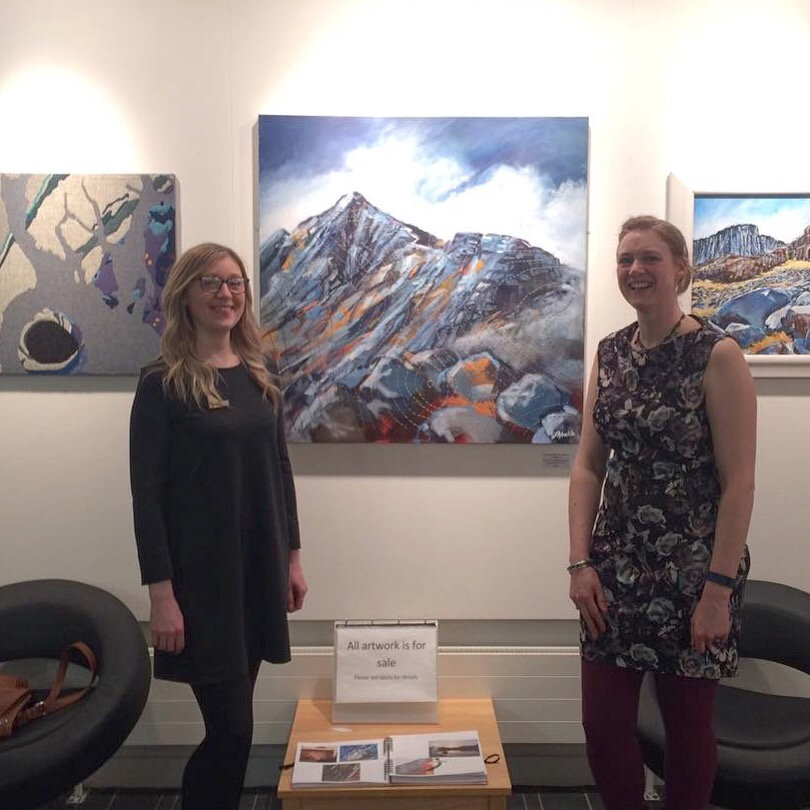
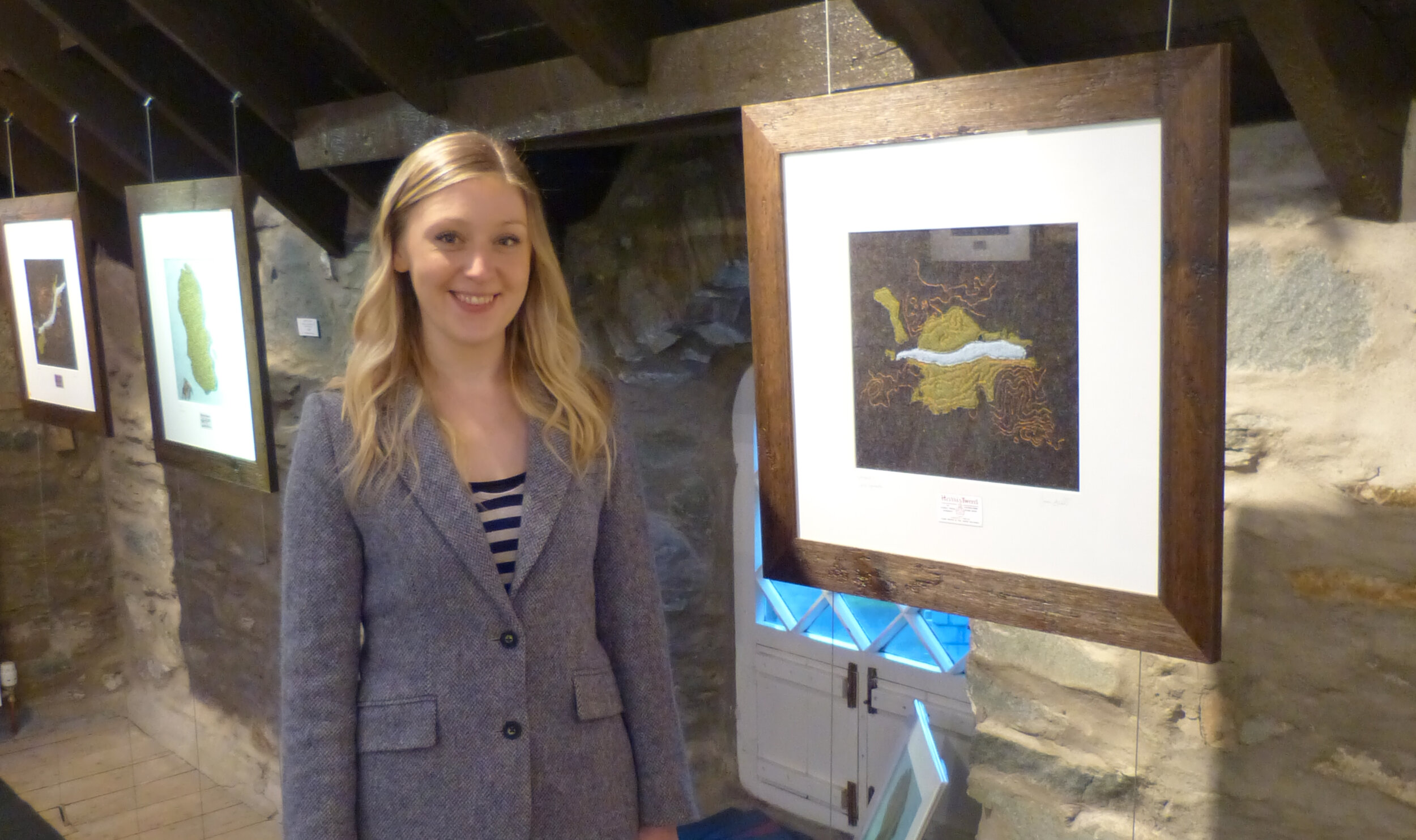
Jane at the opening of HUSH

Jane at the opening of HUSH

Sheared, Jane Hunter, 2018

Sheared, Jane Hunter, 2018

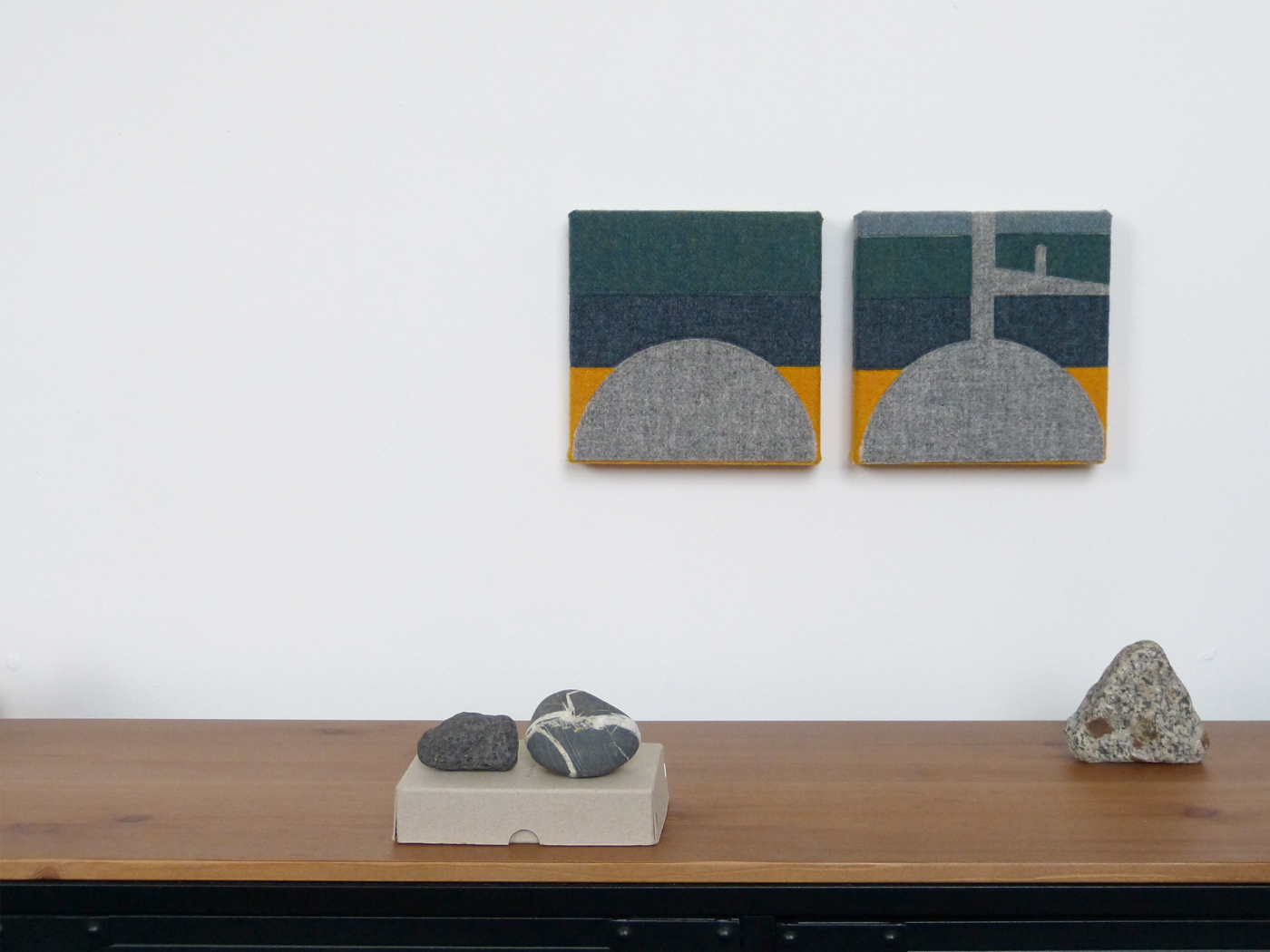
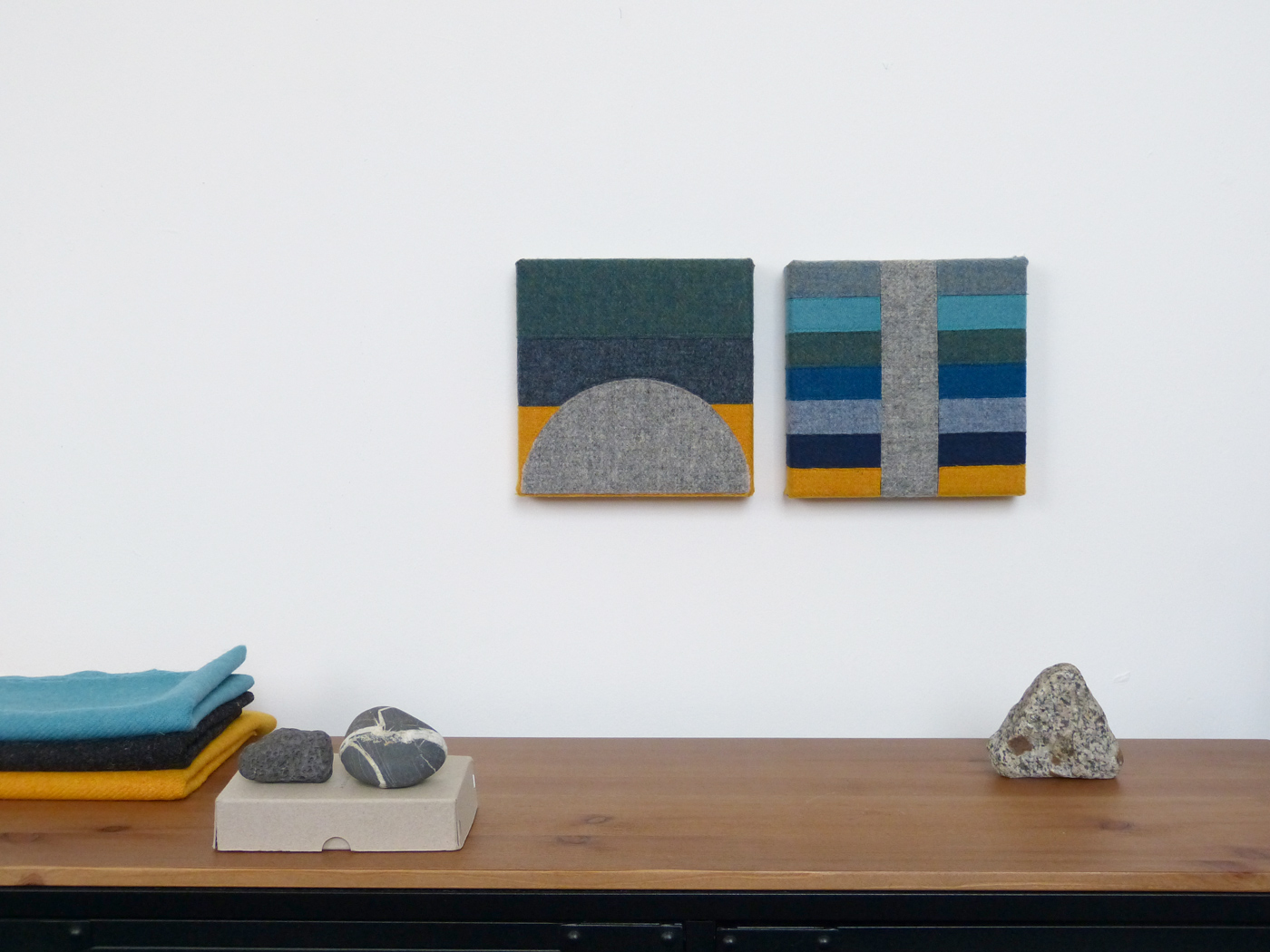
Shelter 1, 2 & 3, Jane Hunter, 2018

Shelter 1, 2 & 3, Jane Hunter, 2018

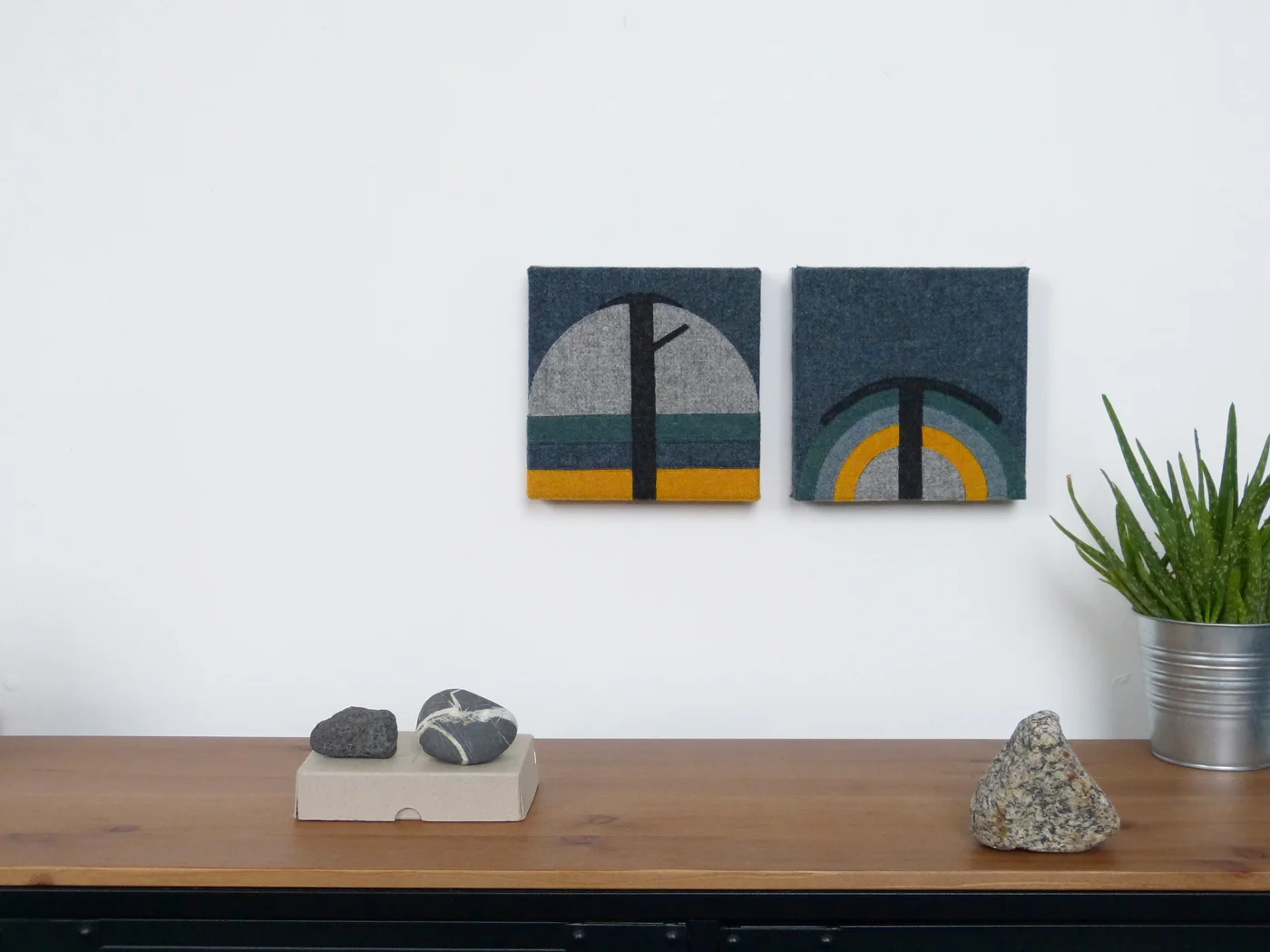
Shelter of the Kyles, Jane Hunter, 2018

Shelter of the Kyles, Jane Hunter, 2018

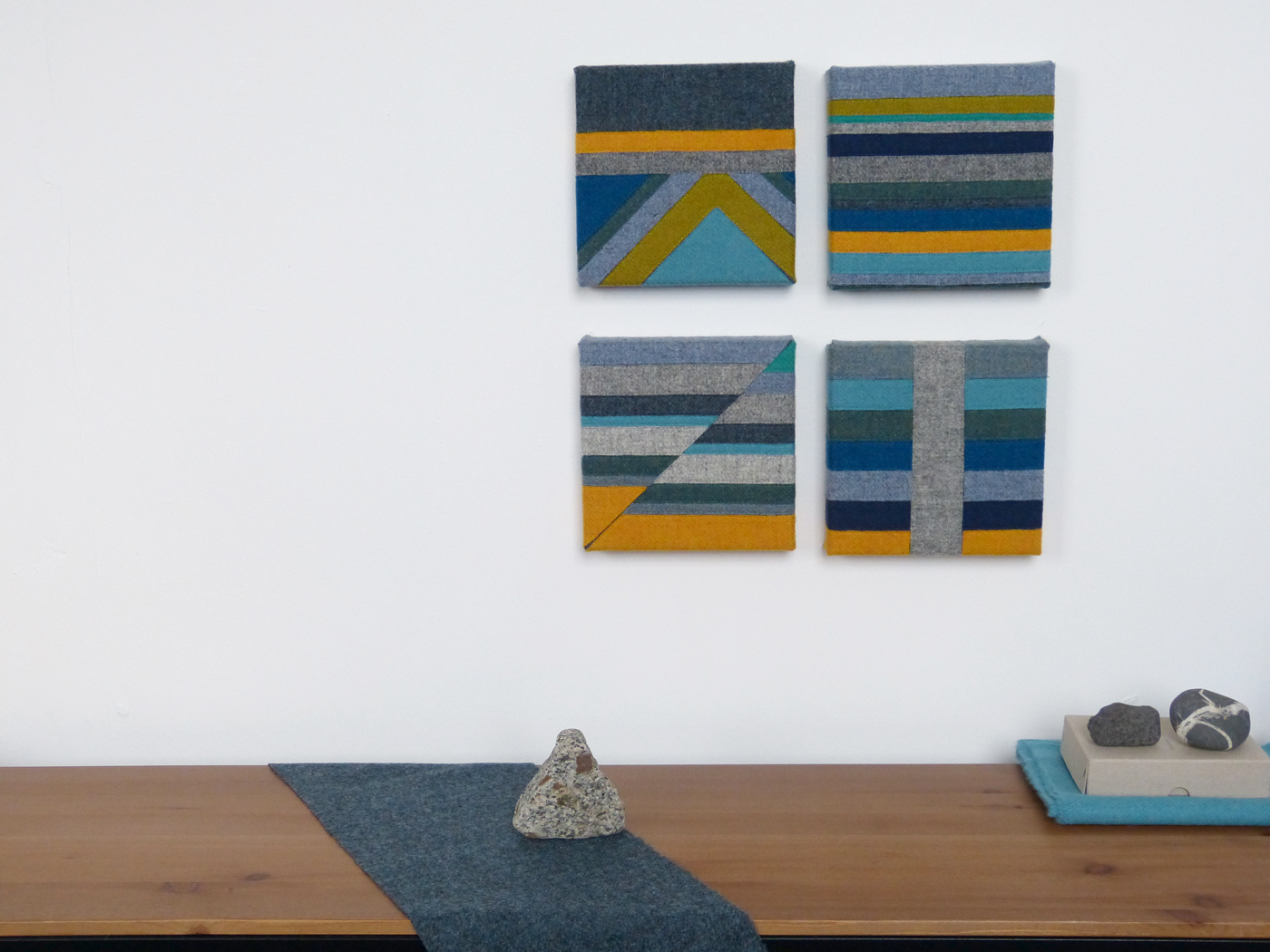
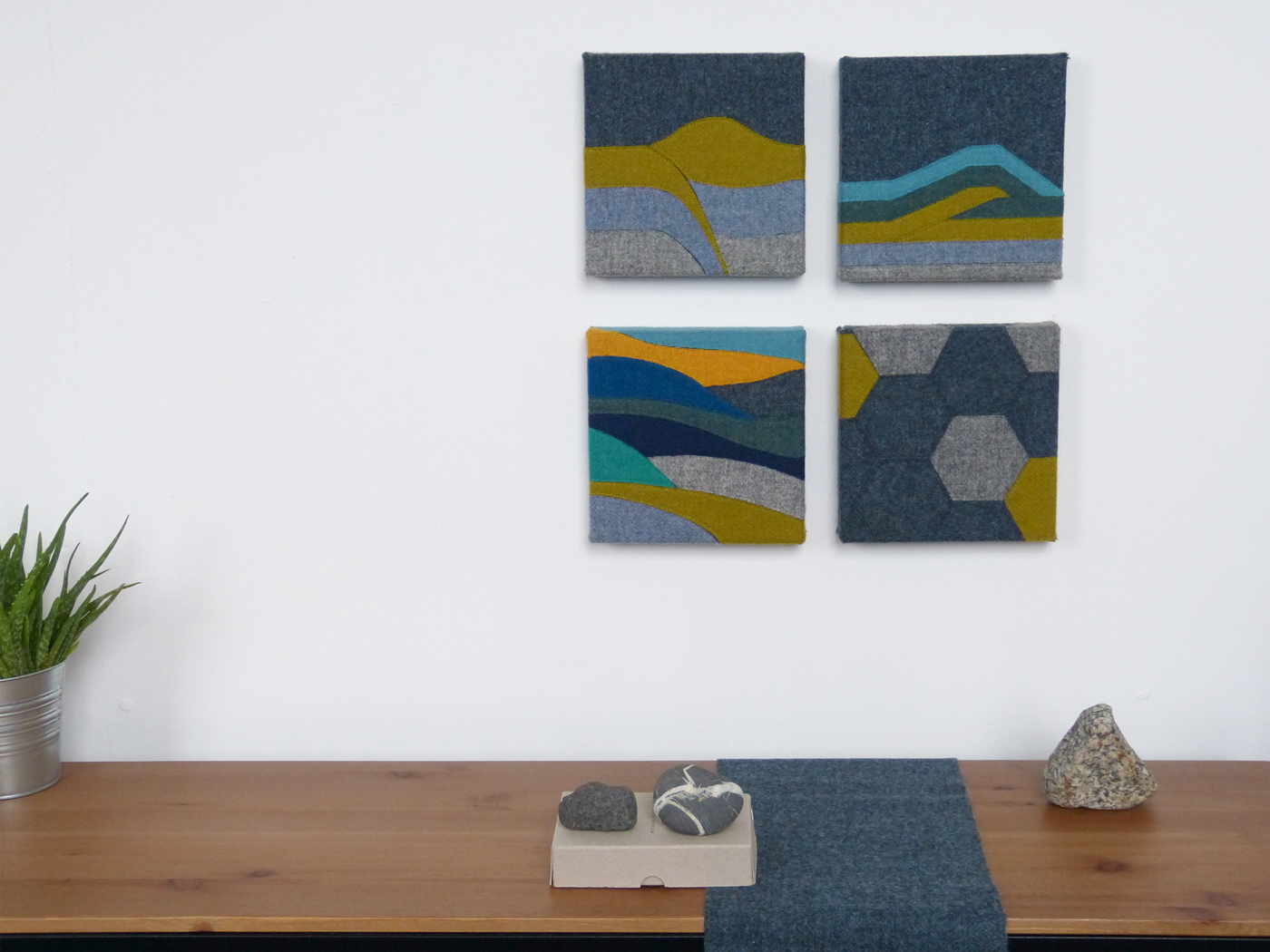
Rock Study 1, 2 & 3, Jane Hunter, 2018

Rock Study 1, 2 & 3, Jane Hunter, 2018

Narrows, Jane Hunter, 2018

Narrows, Jane Hunter, 2018

Enquiries to Tighnabruaich Gallery: +44 (0)1700 811 681

info@tiggallery.com


In early 2017 Ros McKenna from the Tighnabruaich Gallery invited me to explore the Cowal Peninsula, making a new body of work to exhibit in the gallery in the summer of 2018. 

Place is central to my work, when travelling through Scotland I often find myself captivated by the landscape; drawn in by interesting geological features, topographical shapes, dramatic mountains, high cliffs or vast wild spaces.However, when Ros approached me about this project I realised I had never really explored the area known as ‘Argyll’s Secret Coast’, in all my reading about geology, studying maps and walking the hills, it was an area I had overlooked. Although, the peninsula does make an appearance in one of my previous works ‘Highland Boundary Blues’ taking inspiration from the geological fault line which formed during the Caledonian Orogeny and defines the boundary of the ‘Highlands’. The Cowal Peninsula lies to the north of the fault line and the landscape here is rugged, dominated by the metamorphic rocks known as the Dalradian and shaped by glaciers. 

I guess I’ve overlooked this area due to there being none of the ‘flashy’ geology or mountains I had been drawn to over the previous years. No Munros to summit, no ancient remnants of volcanoes like Skye or Glen Coe and no famous features like the Moine Thrust exposure or ‘island mountains’ of Assynt. Many visitors overlook this peninsula due to, what you might call, ‘topographical difficulties’. Bound by the fjord like channels of Loch Fyne to the west and Loch Long to the east it can feel like a long journey to get there, not somewhere you pass through and perhaps a contributing factor to why it remains a ‘secret’. There was therefore a significantly different approach to the making of this new body of work for me, the connection to the place, the landscape, had not yet been made. There was no immediately obvious spark to lead me down a path of research, and very few publications about the landscape for me to reference. What I did have though was time, time to spend just being there. Travelling from the central belt, taking the ferry from Gourock, you can be in Cowal in less than two hours and feel like you’re a million miles away. I also had the wonderful support of the gallery, Ros has been there at every stage with passion and encouragement, allowing me total freedom in the work I was to produce. I can’t stress enough how important this has been. It can be a high pressure situation making a whole exhibition of work for a gallery, always with the wee voice at the back of your mind reminding you that the gallery needs to sell this work, so to be encouraged to explore new ideas, techniques and produce quite different work was a wonderful experience. 

I made several trips to the area and throughout the time I spent there fell quite deeply in love with the blissful quiet that dominates. The hush. These western peninsulas of Cowal can be described as quiet in many ways: it is not highly populated, there are no hoards of tourists and none of the noise pollution we endure in our cities. When I began to look for inspiration in the geology, quiet was a word that came to mind here too. As I said before, no flashy volcanoes or famous unconformities here. What I came to discover though, is that without that immediately obvious spark of inspiration I was compelled to look deeper and spend time contemplating what the landscape had to say. I eventually found an old report, from 1974, which was commissioned to investigate the coastline of Cowal, rates of change, land use, accessibility and conservational value. Again the word quiet was prevalent in the descriptions of the beaches and waters. ‘low energy environments as a result of restricted fetch sectors and of interference by sheltering islands and adjacent coasts. The sea lochs and narrow straits such as the Kyles of Bute are particularly sheltered.’ and so from this, the spark.

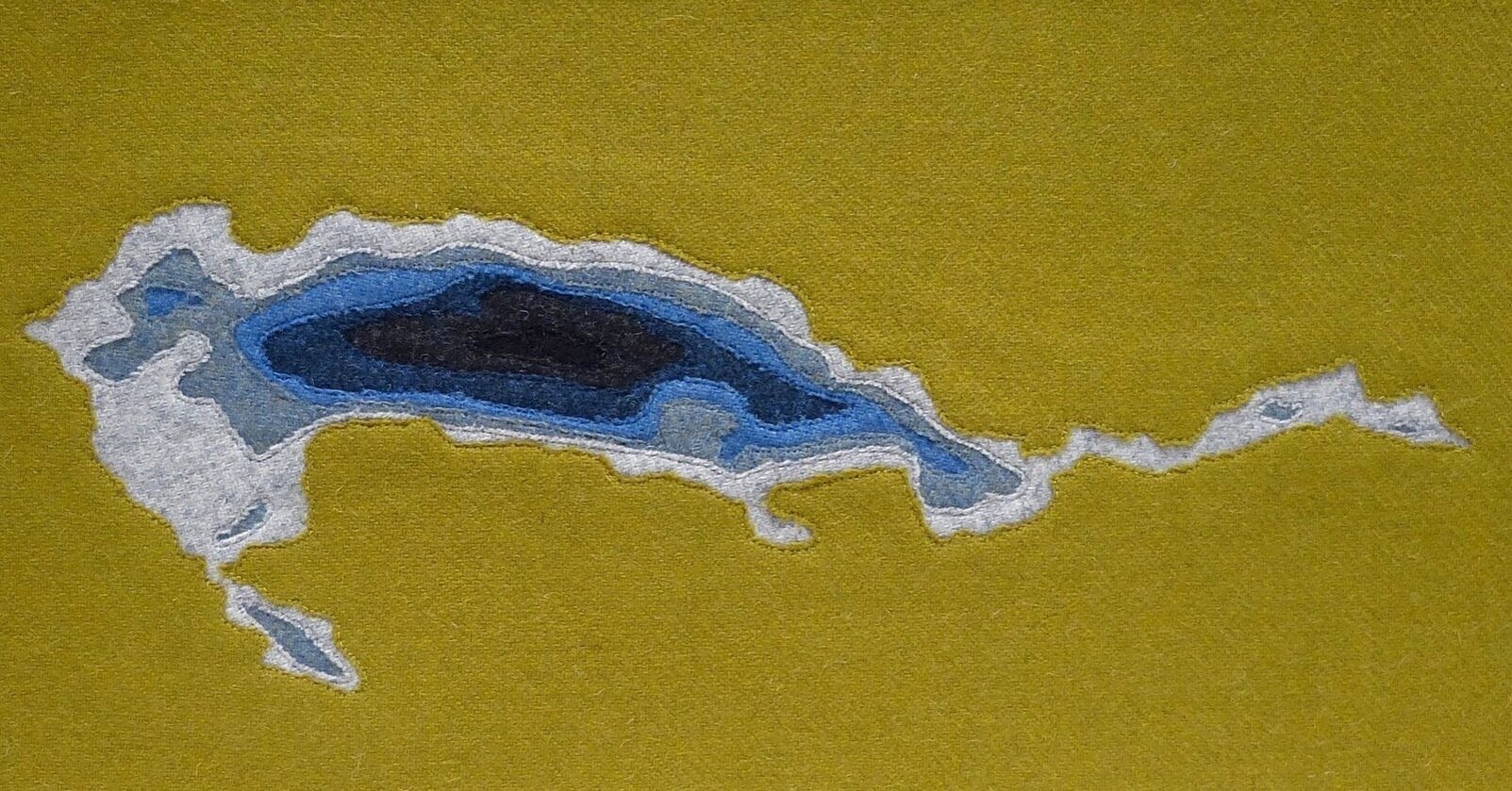
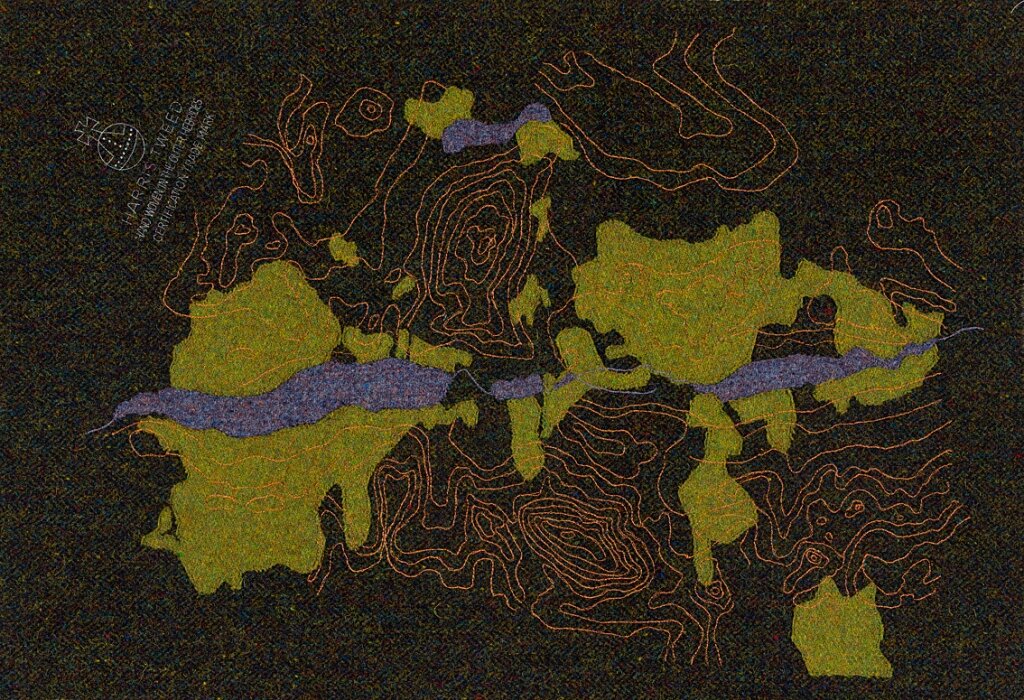
I mentioned that this landscape is rugged and in the description of terrain it is; rough, rocky, hilly. However it is also rugged in the sense you might describe a face, not in a harsh or stern way but wrinkled or furrowed by experience. Gently rugged perhaps. There is a calmness and as I sat on the shore it was the hush that spoke most loudly to catch my attention. Sheltered bays and inlets, the gentle sound of the water and wildlife, protected by the undulating hills and neighbouring islands. The long penetrating stretches of water create the feeling of being on an island, the sea so often at your side. The images I have made explore this place from several different perspectives, from macro to micro, and are all shaped by the overwhelming ‘Hush’. My palette of Harris Tweeds, and the soft warm natural qualities of the wool, lend a thickness and texture to this work which I feel echoes the hush; absorbing sounds and reminiscent of grass or moss underfoot absorbing my footsteps as I walked in the landscape. The huge geological forces which resulted in the distinctive shapes and forms in ‘Kyles of Bute, Sheared’,  where I took an observation of this iconic view and combined it with the shapes and colours of geological research. Delving into the narrow channels of the kyles expressing their depths and and shallows with layers of cloth and stitches, details studied to this day by sailors seeking shelter in these waters. 

In the 1974 report I was instantly drawn to a section which explained, by means of measuring and expressing in diagrammatic form, the exposure of the coastline and its vulnerability to the effects of the wind. In my series of ‘Shelter’ diptychs I have re-made these diagrams, coupling them with a graphic aerial representation of the corresponding bay, communicating how the water shapes it and the surrounding landscape protects it. “Exposure roses were constructed by measuring the slope (in percentage form) from mid-tide level at the centre of the beach to each of the eight main compass directions, and hence by drawing rays proportional to the slope in each direction. Steep slopes, represented by long rays and hence by large roses, imply a large amount of topographical shelter around the beach, while short rays and small roses indicate that there is little shelter.” A noticeable feature of the rock around Cowal is its layered appearance. From the large exposures on the shores to the small pebbles I collected, layers can be seen. This is due to the way this rock was formed, originally deposited as sediment in deep seas and later altered by metamorphism resulting in this sheetlike orientation of the mineral constituents, or schistosity. In my small series of ‘Rock Studies’ I took inspiration from these forms and patterns observed in the rock, appreciating their natural uniformity, complexity and how the environment has shaped them over time.

The depiction of a ‘view’, in the classic landscape sense, is something I had veered away from in my practice until the beginning of this year. A subject I have written about previously and an idea I was given the opportunity to expand on through my piece for The Argyll Collection Exhibition, also hosted by Tighnabruaich Gallery. I have very much enjoyed experimenting with this new way, for me, of communicating and reinterpreting the landscape. I see colours and abstract shapes created by sand, water, rocks and trees and how the light plays on each. I reduce these elements to simplified forms, essential visual information about the landscape. Each shape is hand cut and stitched to form an interlocking combination of shapes, texture and colour. 

The outcome of the alternative approach to this body of work has been interesting to me. Rather than taking the area and ‘putting my spin on it’ or simply applying my creative style this new landscape, the place guided me to what the work would be. I allowed myself to be fully immersed in my surroundings, notice and appreciate all the tiny details with all of my senses, without the distraction of the obvious. I am really proud of the work and excited about these new directions it has opened up. 

The promise of all that sea...

“Sanday - The promise of all that sea, but anchored in the knowledge of a return home”

A view of these islands in the north with shape and colour communicating the geological make up of the landscape. Colours observed and taken directly from this place, the blues in the sea and sky, white gold sweeps of the sand and lush greens of the fields and machair. 

The island provides the anchor with equal prominence give to the vast seas stretching from the shore. Stepping further into the water stitched contours of the sea bed are revealed and strong strands of wool, anchored at Scar beach, reach out to the possibilities it holds.  

The-Promise-of-all-that-sea-anchored-in-the-knowledge-of-a-return-home-Jane-Hunter-Art-Orkney copy.jpg
Sanday-Art-Promise-of-the-Sea.jpg

Commissioned textile work. Referencing nautical charts, geological maps, the client’s own expeditions and the colours discovered on location.

Sketchbook on Sanday, Orkney

Sketchbook on Sanday, Orkney

Sanday Jane Hunter Artist.jpg

The Argyll Collection - Jennifer Hex

Initiated by gallerist, Rosalyn McKenna, I embarked on an exploration of the work of Jennifer Hex (1938 - 2016). Discovering similarities with how both she and I view and understand landscape and make our work.

Kilbride Bay Study 1, Jane Hunter 2018

Kilbride Bay Study 1, Jane Hunter 2018

Gott Bay Study 2, Jennifer Hex (image courtesy of The Argyll Collection)

Gott Bay Study 2, Jennifer Hex (image courtesy of The Argyll Collection)

Earlier this year I was invited to be involved in an interesting project by Rosalyn McKenna of Tighnabruaich Gallery. 

‘Paintings are for People’ - "The Argyll Collection was established between 1970 and 1990 as a learning resource for the young people of Argyll and Bute. The collection consists of 173 pieces including prints, paintings, ceramics, textiles, drawing, sculpture and mixed media works, covering a wide range of subject matter. It has become a snapshot of Scottish art and is an important public asset and a rich and relevant teaching aid. Tighnabruaich Gallery are proud to announce that they will be  hosting an exhibition of a  selection of works from the Collection displayed alongside work by our own gallery artists. There will be an accompanying programme of talks, workshops and tours.There will also be a sister exhibition on display at the Burgh Hall, Dunoon."  

This collection of artworks was purchased by Argyll and Bute Council as a resource for schools. “At the time of its inception it was believed that young people in the area did not have the same access to museums and galleries as their contemporaries in other parts of the country. The aim of the collection was to redress this situation by allowing young people direct access to a wide variety of quality art. The works would become an important teaching aid which would allow students the experience of viewing and connecting with genuine art”


When Ros got in touch about the exhibition of work at her gallery she asked me to look through the collection online and see if a particular piece resonated with me. The idea being that I would then make a new piece in response which would be displayed alongside. Ros mentioned that she had an idea which artist I might choose, but didn’t tell me which as she didn’t want to influence me! 

There are so many stunning artworks in the collection and so I began listing pieces that inspired me, however as soon as I saw the work of Jennifer Hex the decision was made. Working with textiles and embroidery, observing the light and colours of the west coast and using a combination of hand and machine embroidery it seemed the natural choice. This wasn’t the only connection I felt with her though. Two works in particular stood out - Gott Bay, Tiree and Gott Bay Study 2 - the abstract shapes and restricted colour palette were telling their story in a language which was very familiar to me. 

Jennifer-Hex-Gott-Bay-Argyll-Collection.jpg

'Gott Bay, Tiree - Jennifer Hex. Image courtesy of The Argyll Collection.


Jennifer Eda Hex was born in London in 1938, but shortly afterwards moved to Kilbirnie, Ayrshire, her mothers home town. Sadly Jennifer passed away in 2016 and despite searching for more information about her and her work, the only piece of writing I have found is an article from the Campbelltown Courier published on 4 Nov 2016 - Jennifer Hex: 1938 - 2016 - an appreciation. This article gives a brief account of her studies at Glasgow School of Art, teaching positions in local high schools and time as an artist in residence in Argyll. As I can gather from this short account, she seems to have lived a full and creative life, and was a woman who gave her time generously to the education of young people. 

However it was the description of her interests, vision and inspirations which made my heart beat a little faster:

“Jennifer had her own particular vision. She saw things that other people tended to overlook or take for granted or pass by; but they were not in any way strange or exceptional things. They were things which we might all see, every day, if we simply possessed a clearer vision of the sort that she had. She saw elemental things: water, air, fire, earth; that’s to say, the sea, rivers, waterfalls - even the very small ones in a burn interested her - the sky, clouds, the moon and stars, grasses and sedges… natural things in movement or flux. (she) manipulated cloth in many ingenious ways; they suggested rock faces or geological formations, the flow and eddies of the River Ness in spate, a big wave breaking over the rocks on Islay.

This was her way of understanding the world. It helps us to see, and adds to our understanding. This is what a real artist does.”


It seems I have found a kindred spirit, someone I did not know existed until this year but whose vision is so very closely aligned to my own. 

Making a piece in response to Jennifer’s work gave me the impetus to finally explore some ideas I have had in my sketchbook for a while. 

Kilbride-Bay-Argyll-Inspiration-Harris-Tweed-sketchbook.jpg

The piece I have made for the Argyll Collection Exhibition, inspired by the work of Jennifer Hex, is titled ‘Kilbride Bay Study 1’. On a visit to Kilbride Bay, Argyll in May 2017 I captured the scene in the photograph below, which immediately came to my mind when I started this project. 

I see colours and abstract shapes created by the sand, water, rocks and trees. Taking each of these shapes and colours, I reduced them to geometric forms, the essential information about the landscape. Each shape hand cut from Harris Tweed and stitched to form a striking interlocking combination of angles, texture and colour.

It retains what I enjoy about a geological map or diagram; shape, form and colour telling a deeper story, but it also evokes a feeling and a memory of the place through those shapes and colours at the same time.

I'm grateful to have been given the opportunity to be involved in this exhibition, learn more about the Argyll Collection and of course to discover Jennifer Hex. When I'm busy working on different projects it can be difficult to allow time for experimentation, to expand on or follow the trail of a thought in my sketchbook. It can almost feel like an indulgence just to spend time in the studio 'playing' with ideas that may or may not go anywhere, but in fact it is really important do exactly that.

So, again, I'm grateful that making this work has allowed me to justify some time to play and in turn delve a little deeper into my motivations and practice.

Kilbride-Bay-Study-1-Finished-Work-closeup.jpg
Jane-Hunter-Kilbride-Bay-Study-1.jpg

The exhibition will run from Saturday 28 April - Friday 1 June 2018 in the Tighnabruaich Gallery. 

Processes

Using colour and form to produce a study of earth forces which shape our landscape.

Process series, Jane Hunter, 2018

Process series, Jane Hunter, 2018

Geological Survey of Northern Ireland

Celebrating 70 years of the Geological Survey of Northern Ireland. This artwork takes inspiration from the geological map of Northern Ireland, using Scottish Harris Tweed and Northern Irish woven cloth from Mourne Textiles.

Textile work, artist talk and subsequent touring exhibition with British Geological Survey.

Landscapes from Stone art exhibition Geolgoical Map of Northern Ireland Jane Hunter.jpg
Jane Hunter - Geology Northern Ireland 2 - web ready.jpg
Jane Hunter - Geology Northern Ireland 4 web ready.jpg
Jane Hunter - Geology Northern Ireland 5 web ready.jpg
Landscapes-from-Stone-Art-Exhibition-BGS-GSNI-Belfast.jpg
Landscapes-from-Stone-Art-Exhibition-for-GSNI-Belfast-1.jpg

Paisley 2021

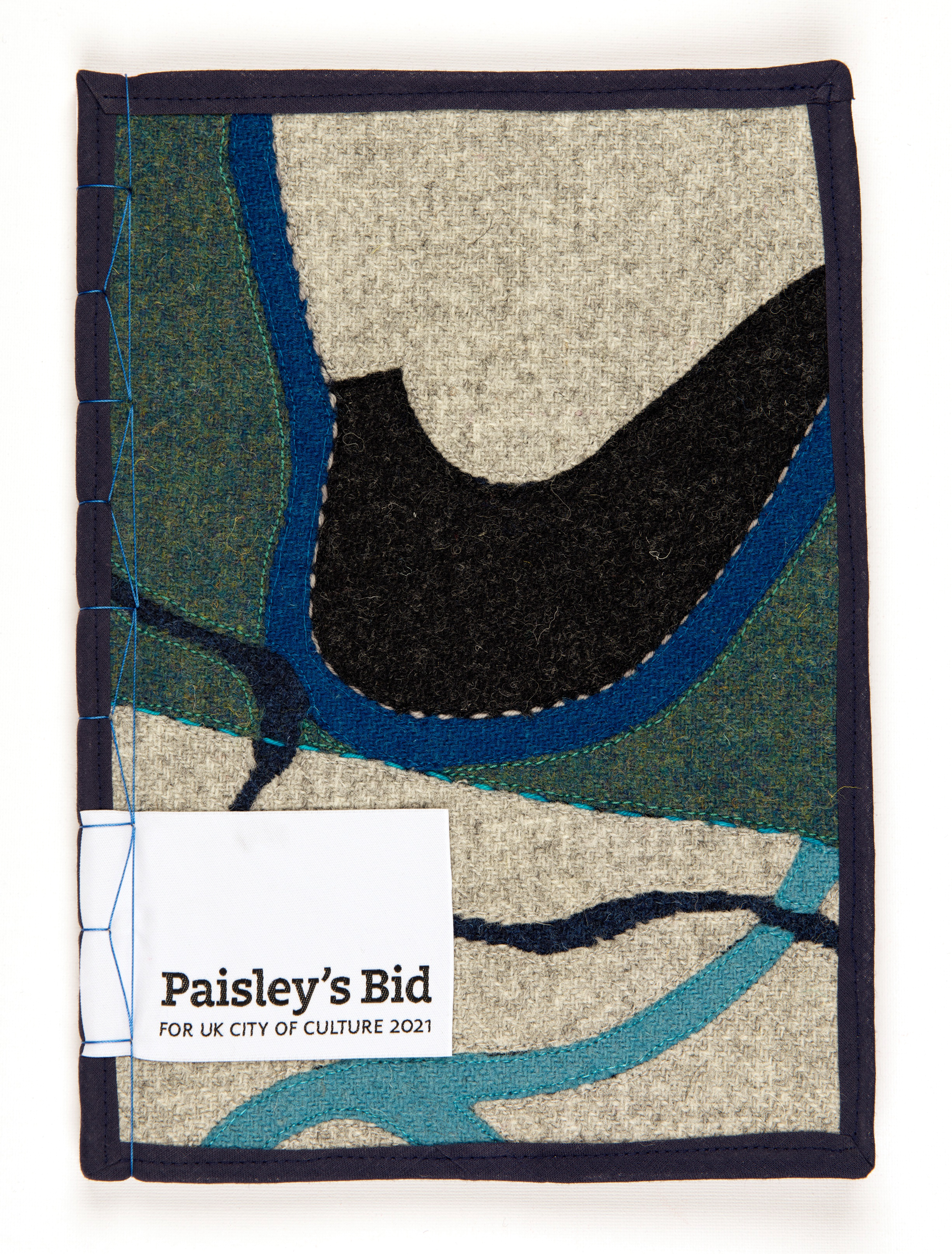
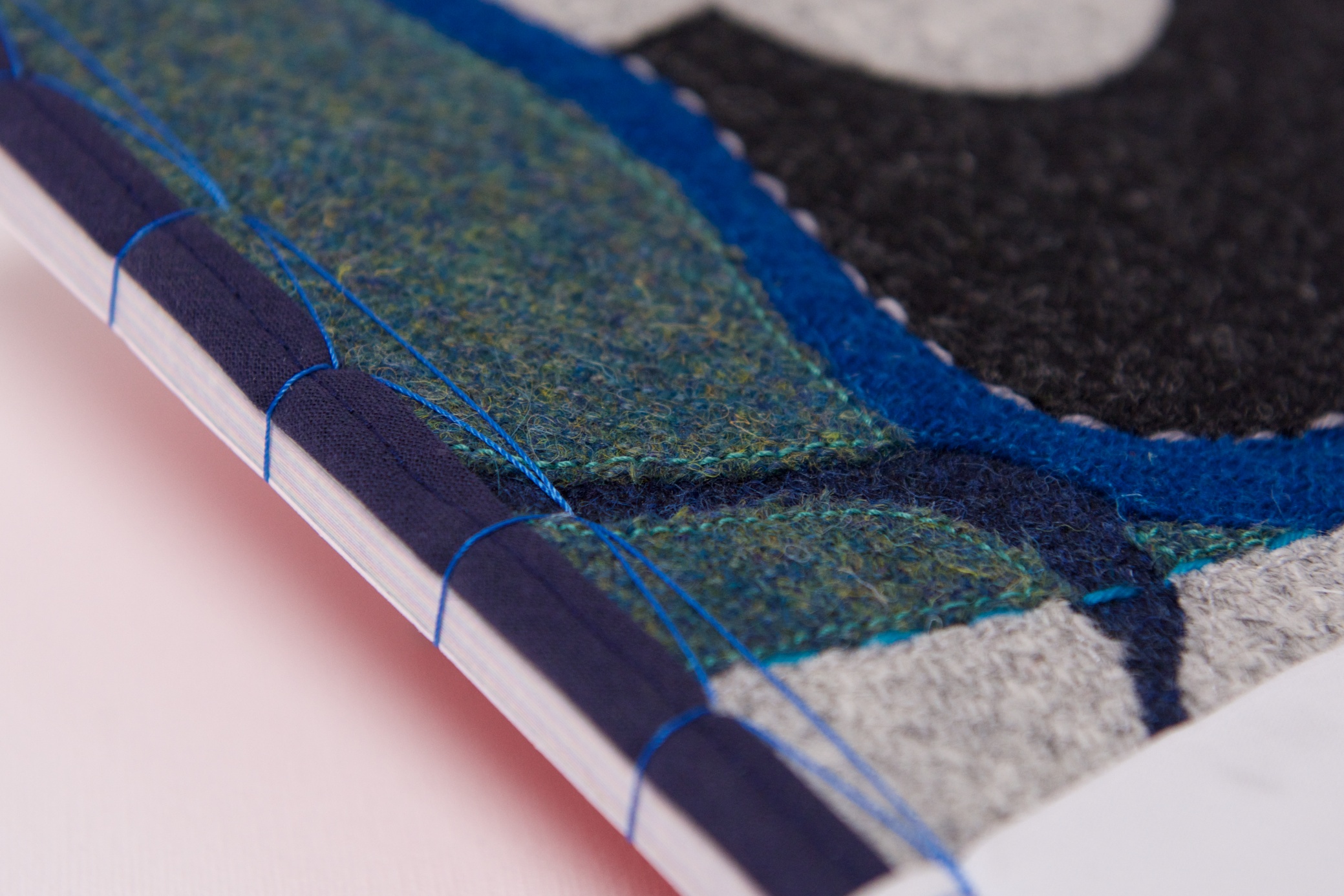
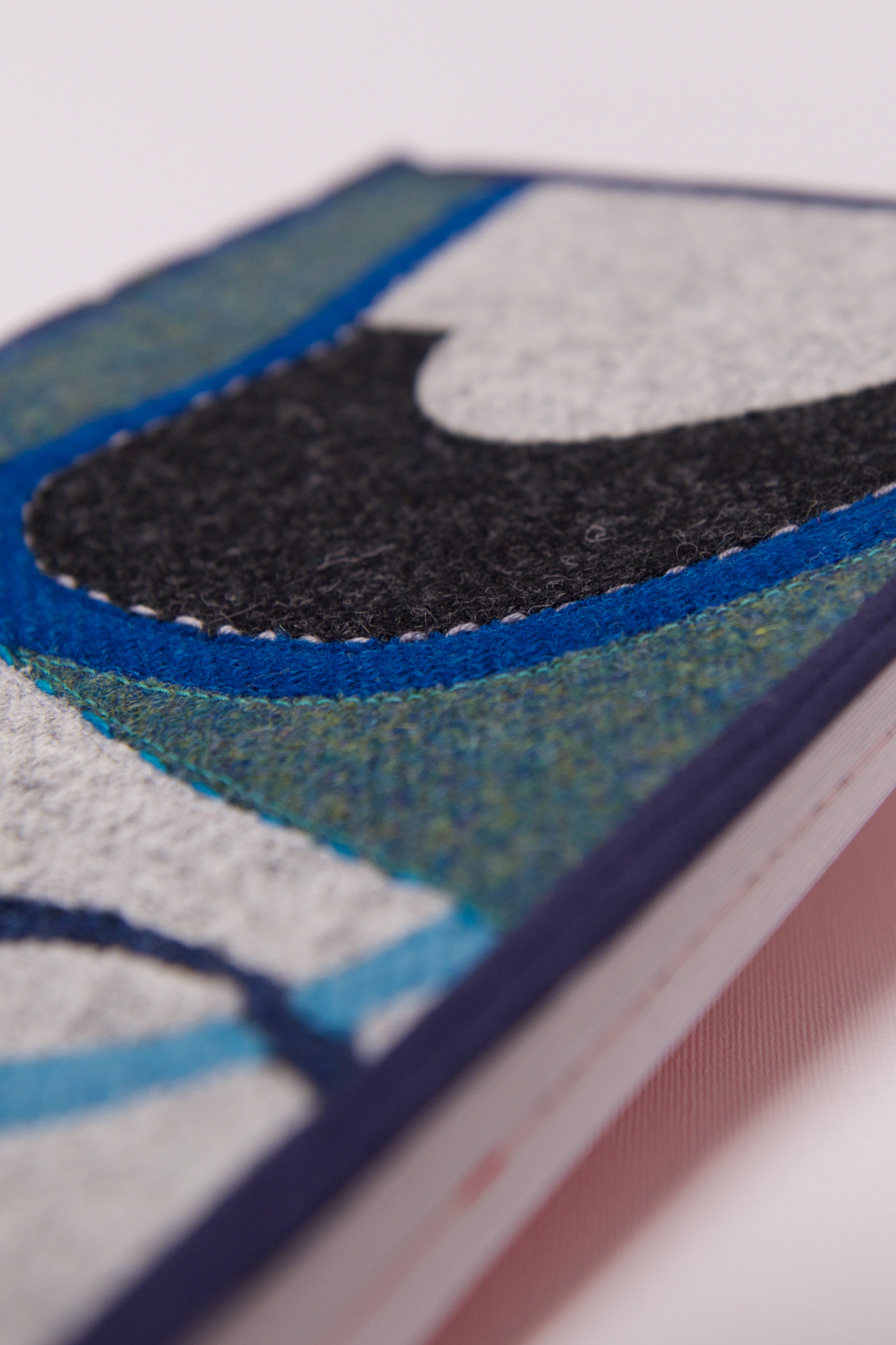
Book Cover Artwork: Paisley’s bid for City of Culture 2021.

Referencing the geology surrounding the White Cart River which forms the foundations of Paisley’s embroidery and thread mills, now repurposed. One of which houses my art studio.

Isle of Raasay Distillery

Textile art commission for the VIP Lounge in Isle of Raasay Distillery. The first legal distillery on the island of Raasay.

Photograph courtesy of Anne Hunter Interiors.

Photograph courtesy of Anne Hunter Interiors.

When I began my research for this work it soon became clear that this was a very special project. Spirit had been distilled here illicitly for generations, but this would be the first legal distillery on the island. 

The Hebridean isle of Raasay lies off the east coast of Skye. Just 14 miles long and 3 miles wide (at its widest point), this is a small island with a tremendously rich history.

The topography and geology is unrivalled in its beauty, character and complexity. A landscape formed by ancient Lewisian Gneiss to the north with Torridonian Sandstone, igneous lavas and granite to the south.

Raasay-Sheep-Jane-Hunter-Art-Scotland.jpg

A once thriving crofting community of around 900, sadly a victim of the Highland clearances, the population of Raasay now stands at 161 (according to the last census). A history best captured perhaps by one of the most significant Scottish poets of the 20th century, Raasay born Sorley MacLean in his poem Hallaig. You can hear Sorley read his poem here in the song of the same name, by the incredible and deeply missed young Scottish musician Martyn Bennett. 

The story behind the new distillery is inspiring, deeply rooted in the place, the landscape and the community. From the mineral rich water which flows over the volcanic rock, down through the sedimentary to an ancient well on site; the local peat and plans to grow their own barley on the island; the re-use of stone and wood from the site in the building itself, to the employment and involvement of many in the community. 

Raasay-Distillery-Rock-Wall-Scotland-Jane-Hunter-Art.jpg

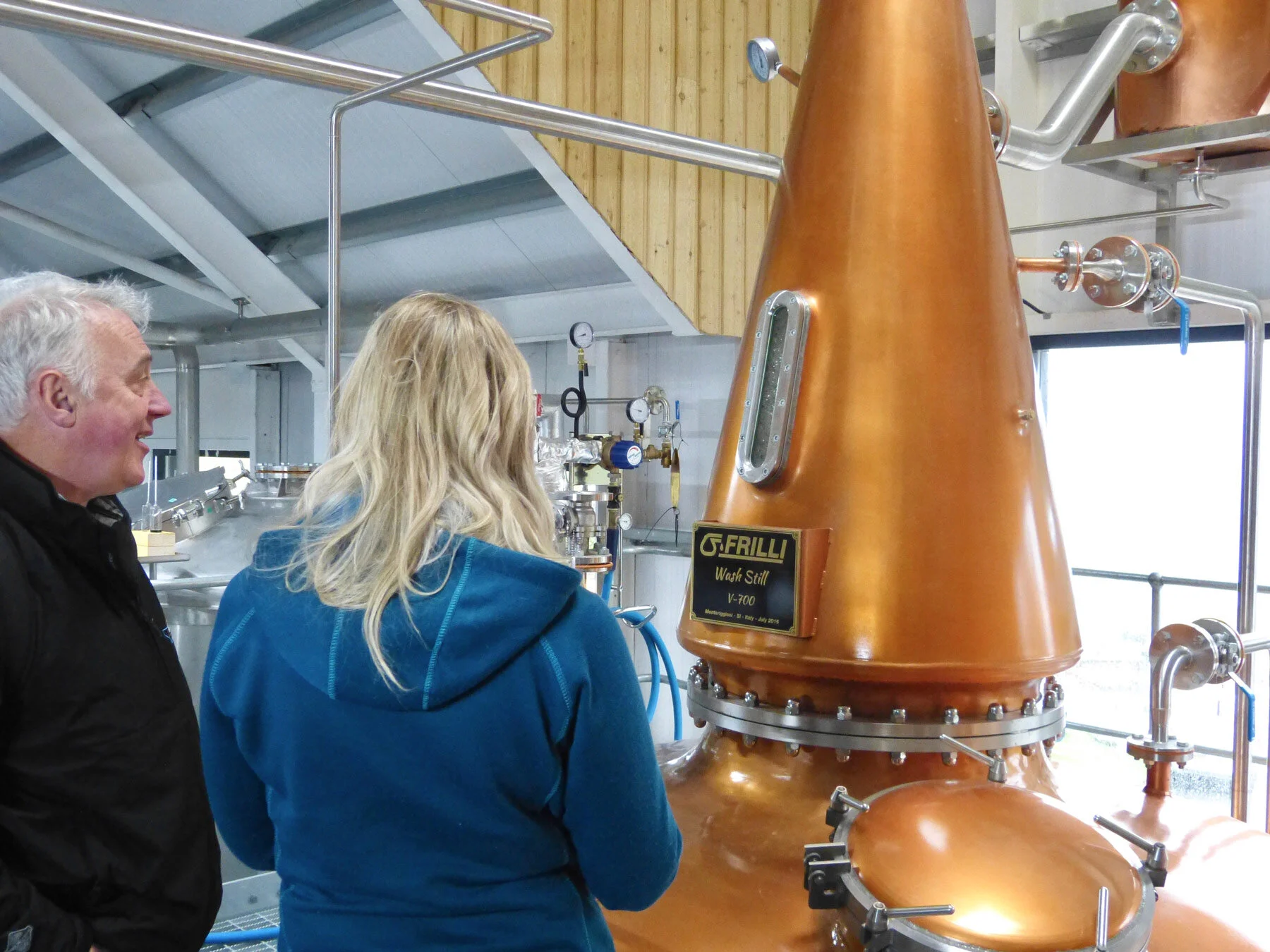
Of course I had to make the trip to Raasay to explore the landscape and have look around the, almost completed, distillery! We were met by Visitor Experience Manager, singer and writer, Iain Hector Ross on the ferry from Sconser. Iain very generously gave us not only a tour of the distillery but also of the island, telling us lots about the history of the place. 

Jane-Hunter-Iain-Hector-Ross-Raasay-Distillery-Tour-2.jpg

The key locations explored in the artwork include the area where the distillery is situated, with the 19th century Victorian villa Borodale House at its heart, the Broch at Dun Borodale and the distinctive flat-topped volcanic summit of Dun Caan. 

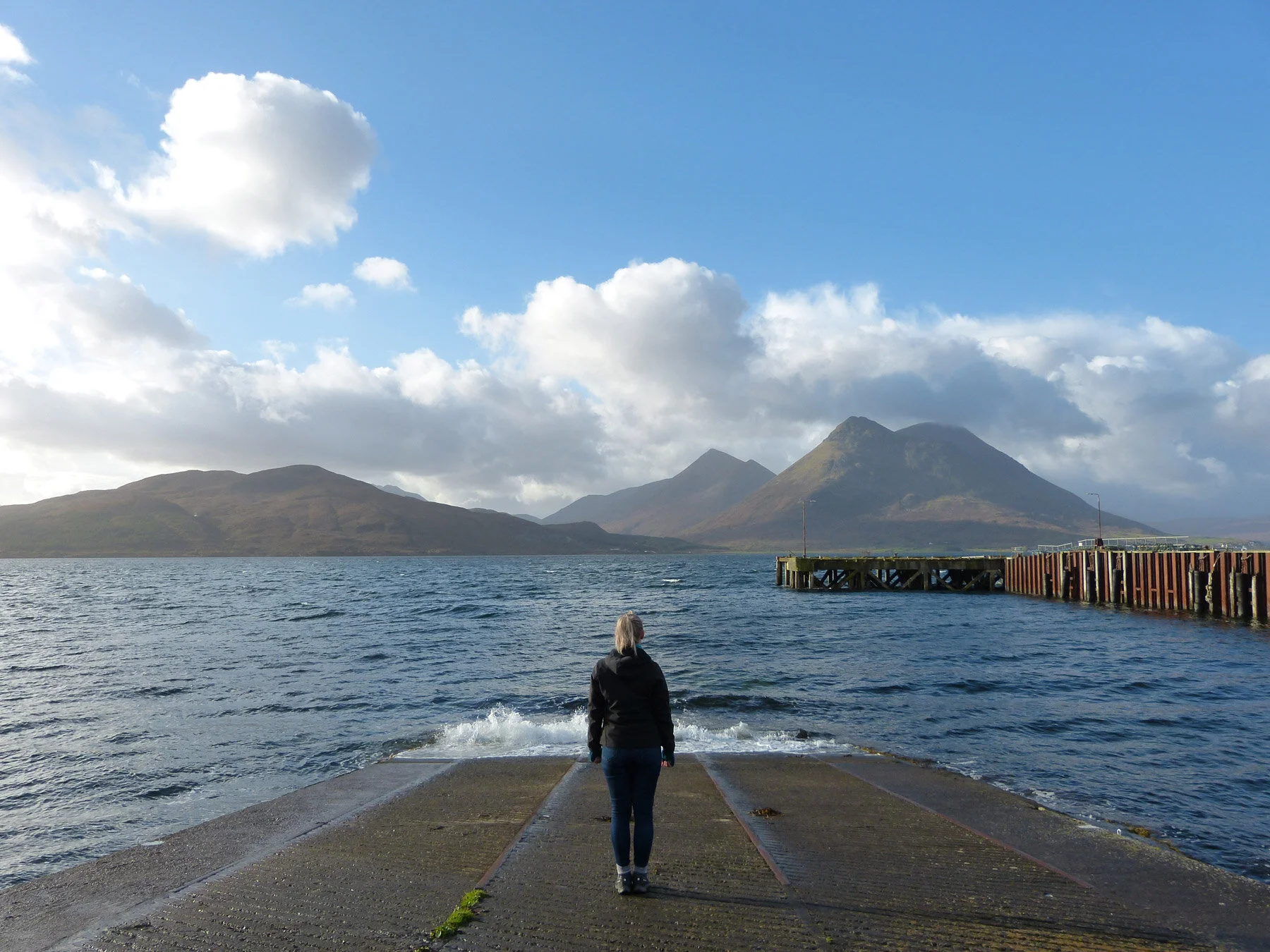
The colour palette is, as always, directly inspired by the landscape. The many shades of green, brown and rust we experienced during our autumn visit to the 'island of the red deer'. The incredible rich blues and greens in the view from the distillery windows across the sound to the mountains of Skye - quite possibly the best view from any distillery in Scotland. 

Autumn-colours-on-Raasay-Island-Jane-Hunter.jpg

Isle of Raasay Distillery is now open to the public for tours and the stunning accommodation available to book, where you'll find my work hanging in the beautiful executive bar & lounge and in one of the luxurious bedrooms.

Raasay-Distillery-Work-in-Progress-Building-Jane-Hunter.jpg

Thank you to Isle of Raasay Distillery and Anne Hunter Interiors for commissioning me for this project. The building itself is just beautiful, a perfect combination of historical and contemporary architecture, with interiors brought back to life through sympathetic restoration and a modern Scottish vision. The result is a stunning place to visit and spend time in.

I'm grateful to have had the opportunity to play a small part in this project and wish the distillery and community all the very best for its success.

Irvine Townhouse

For the re-opening of Irvine Townhouse to the public.

Commissioned by North Ayrshire Council.

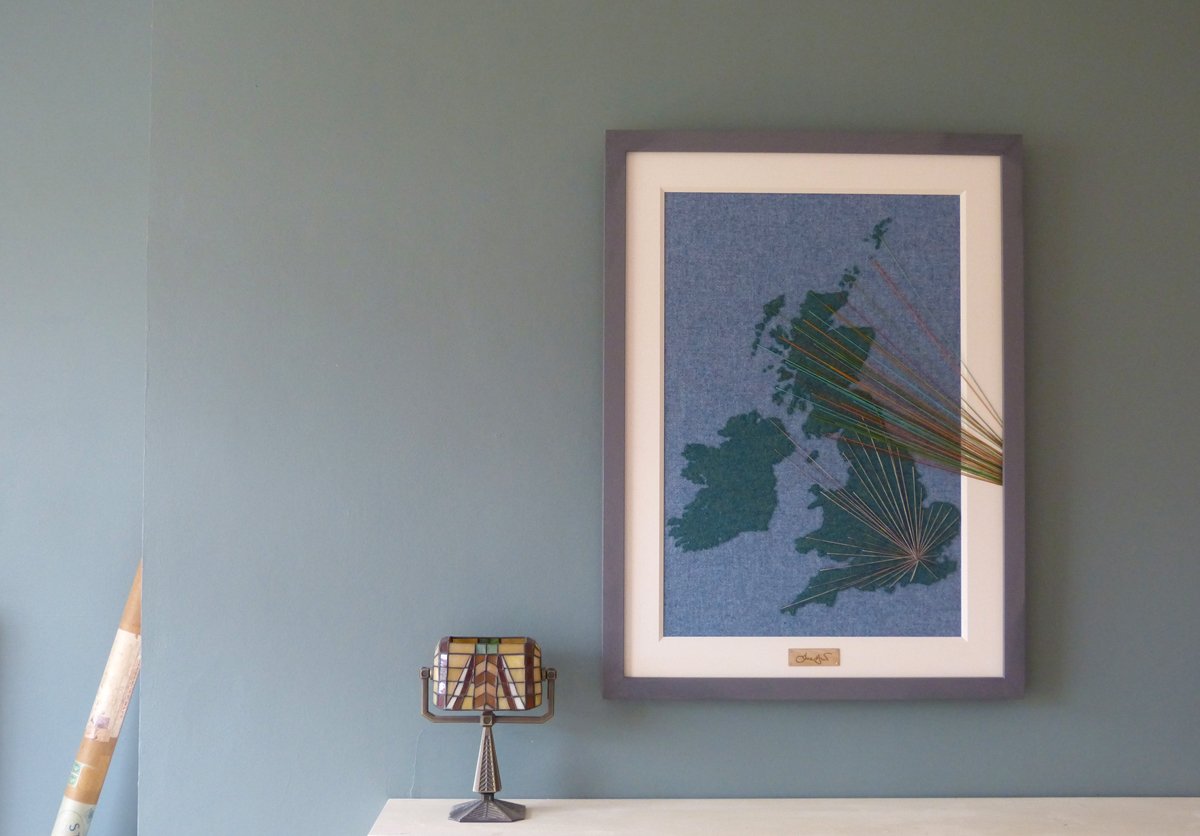
Townscape, bordered by sea, bisected by river, combined with the inward and outward migration of significant historical figures who helped shape the town.

Public Art for local authority in Scotland North Ayrshire Council.jpg
Full Finished Map from Front Door Irvine Townhouse.jpg
Close Up - Irvine Map - Hand Embroidery 2.jpg
Close Up - Irvine Map - Hand Embroidery.jpg

When I was commissioned to create a piece of artwork to hang in the newly restored Irvine Townhouse, I took a slightly different approach than to my previous work. In addition to researching the physical shapes and make up of the landscape, I also looked to the human history of the town to create a map which speaks of the people as well as the landscape.  

The development project integrating the historic Townhouse and the new modern Portal leisure facility, references a link between the old and the new in it’s concept and architecture. This link is strong in Irvine. Designated one of Scotland’s ‘New Towns’ in 1966, to improve housing and employment, Irvine has in fact been settled since the 12th century and was given Burgh status in 1140. The River Irvine played a large part in the success of the town with the port being the third largest in Scotland up until the 18th century. Many local industries, mills, shipbuilding, export and engineering, thrived here until the mid 20th century.

I felt the river should be the starting point for my artwork, the focal point from which the town has grown. Cutting the shapes of the landscape from Harris Tweed, a cloth with a history and heritage of its own, following the twists and turns of the river flowing through the town. Embroidering the streets, I thought about the people who have lived, worked and travelled through this place. There are many famous names associated with Irvine and I discovered that each room in the Townhouse has been named after one of these people. Scotland’s national bard Robert Burns, poetess Jean Kelly, Christian poet and hymn writer James Montgomery, author and entrepreneur John Galt, businessman and philanthropist John Ferguson, Ross Tollerton and Captain Harry Sherwood Ranken both recipients of the Victoria Cross. On reading further I learned of the global reach from Irvine through just these seven individuals. Careers, lives and achievements that stretch from the town to many other parts of Scotland, France, Canada, South Africa, New York and Asia, to name a few. 

I have represented each person on the map with a different coloured thread, rooted in Irvine but reaching, stretching and connecting around the globe. The colour palette I chose for the threads in the map takes inspiration from the original mosaic floor at the entrance to the Townhouse, shades of blue, yellow, russet, and white. Striking against the contemporary grey blue tweed, a palette drawn from the silver birch and waters of the river. 

I hope to achieve in this artwork a feeling of history and heritage, the cloth, craftsmanship and story, within a dynamic contemporary image. Celebrating the joining together of the old and the new.

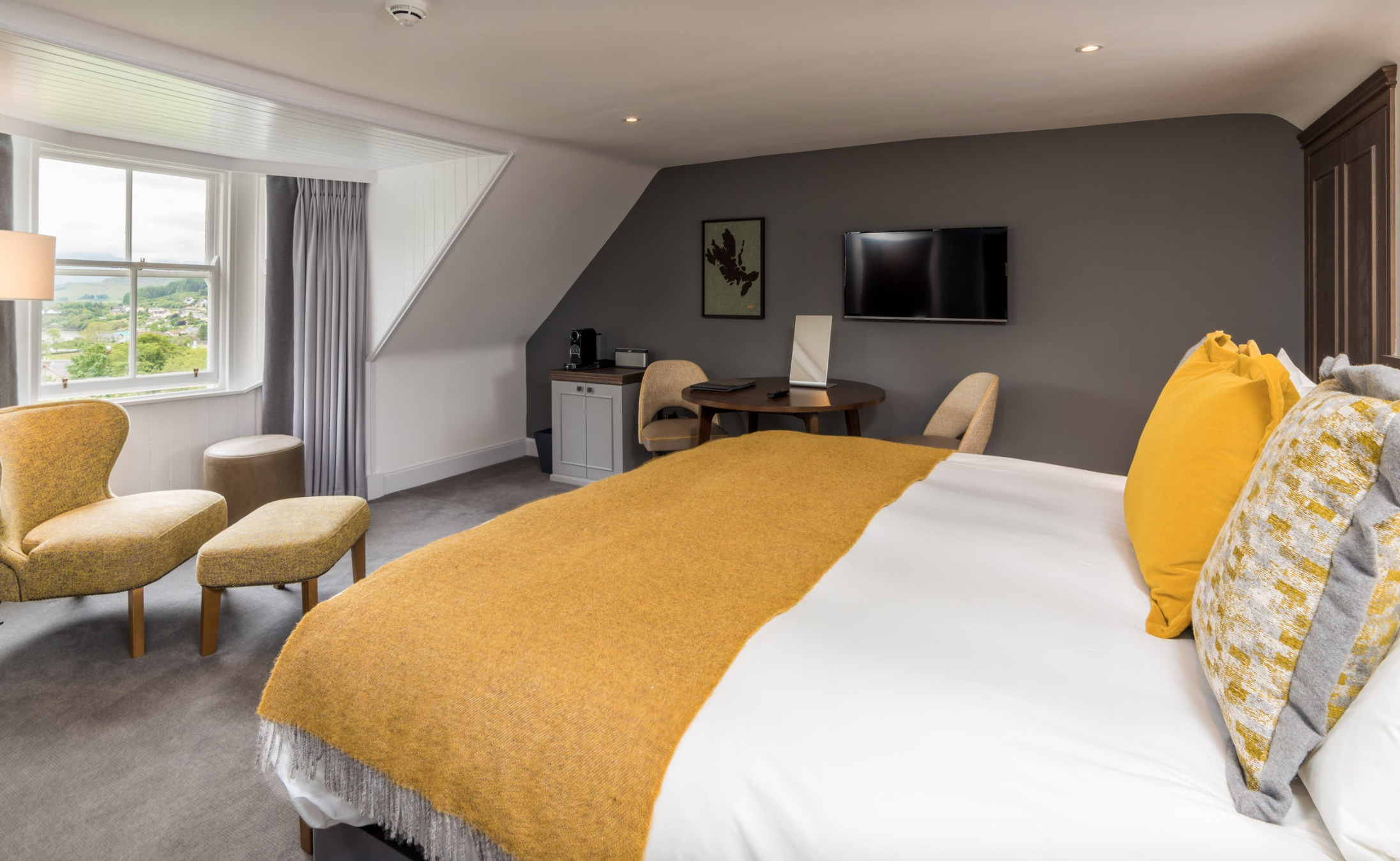
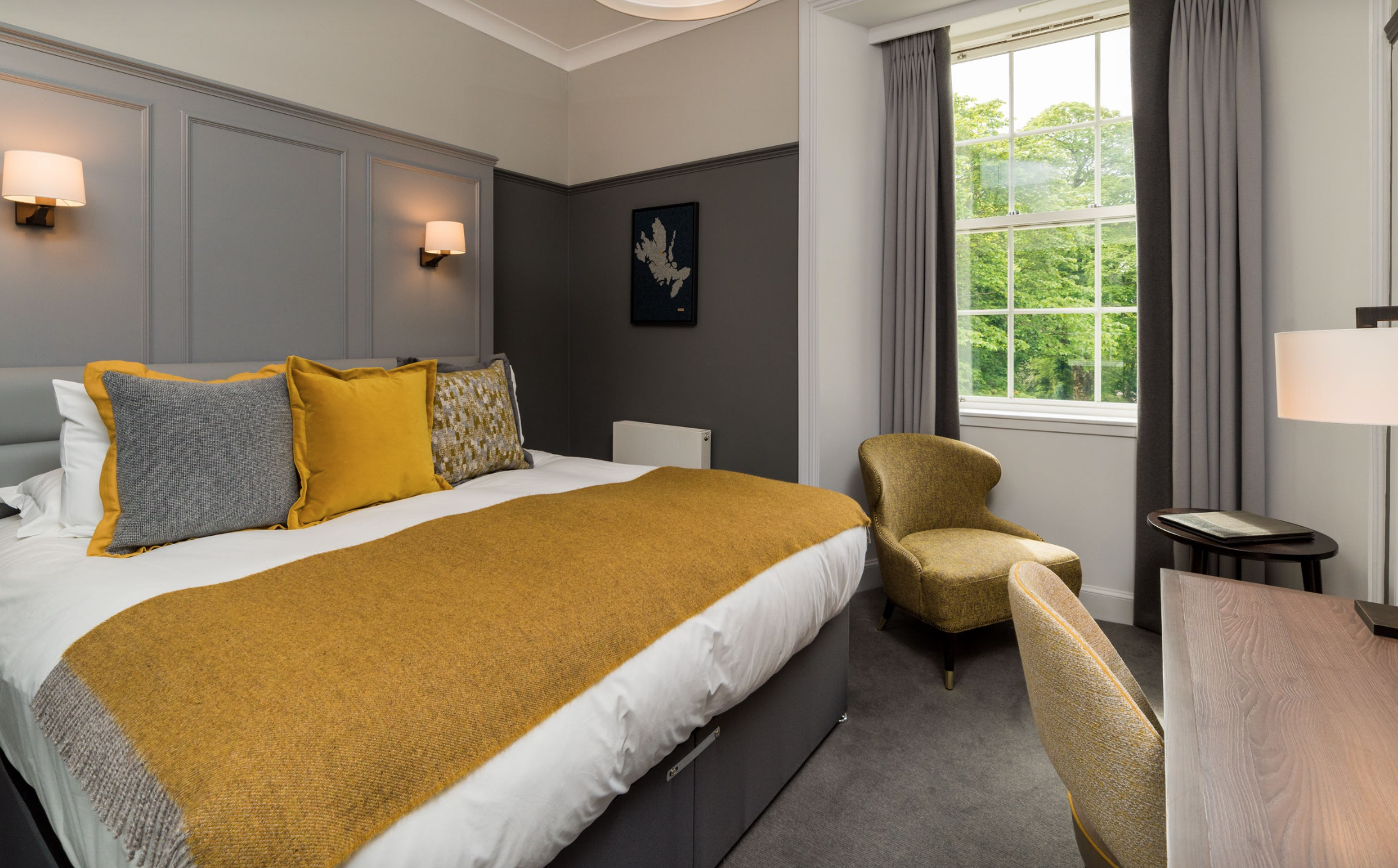
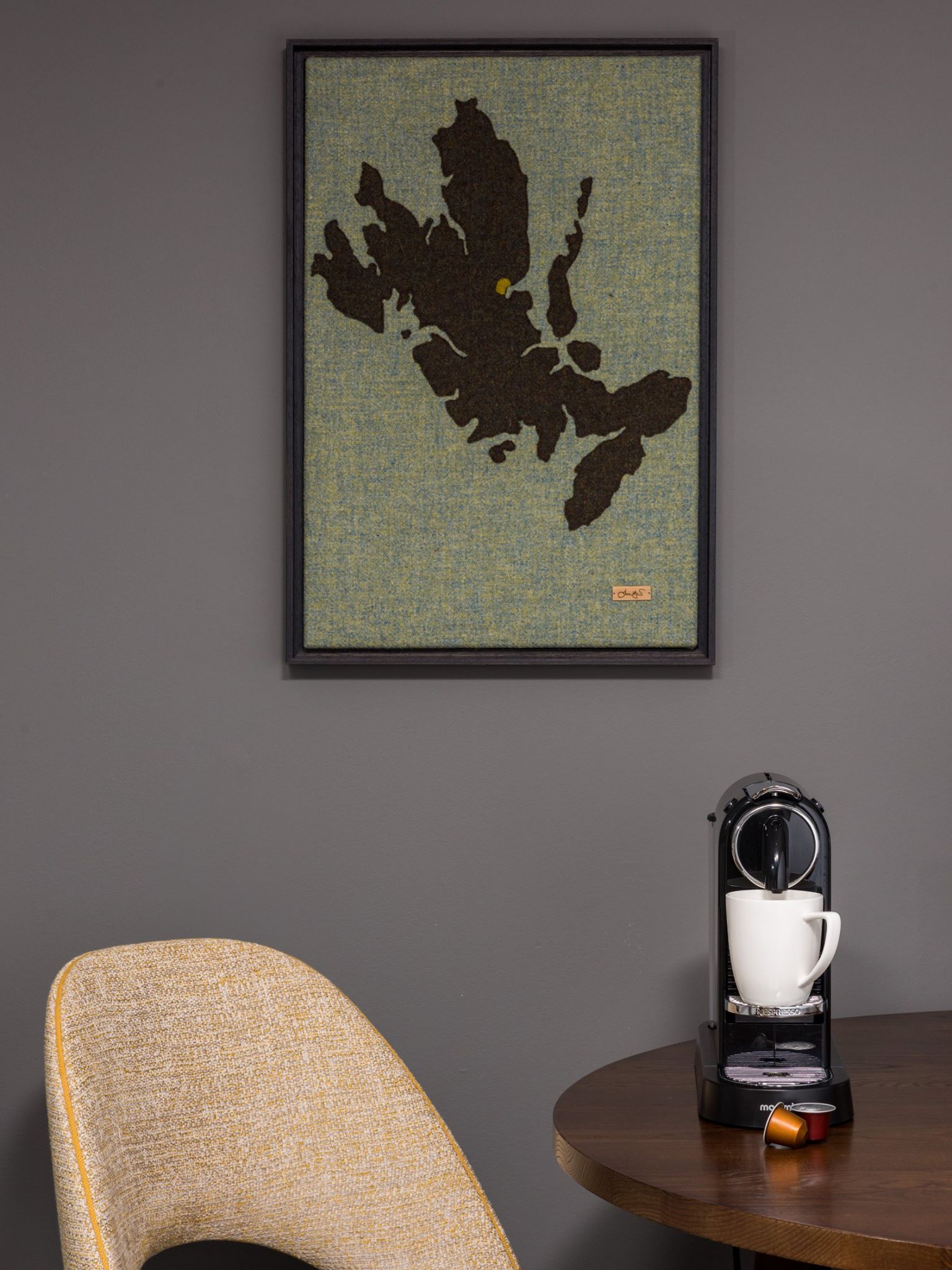
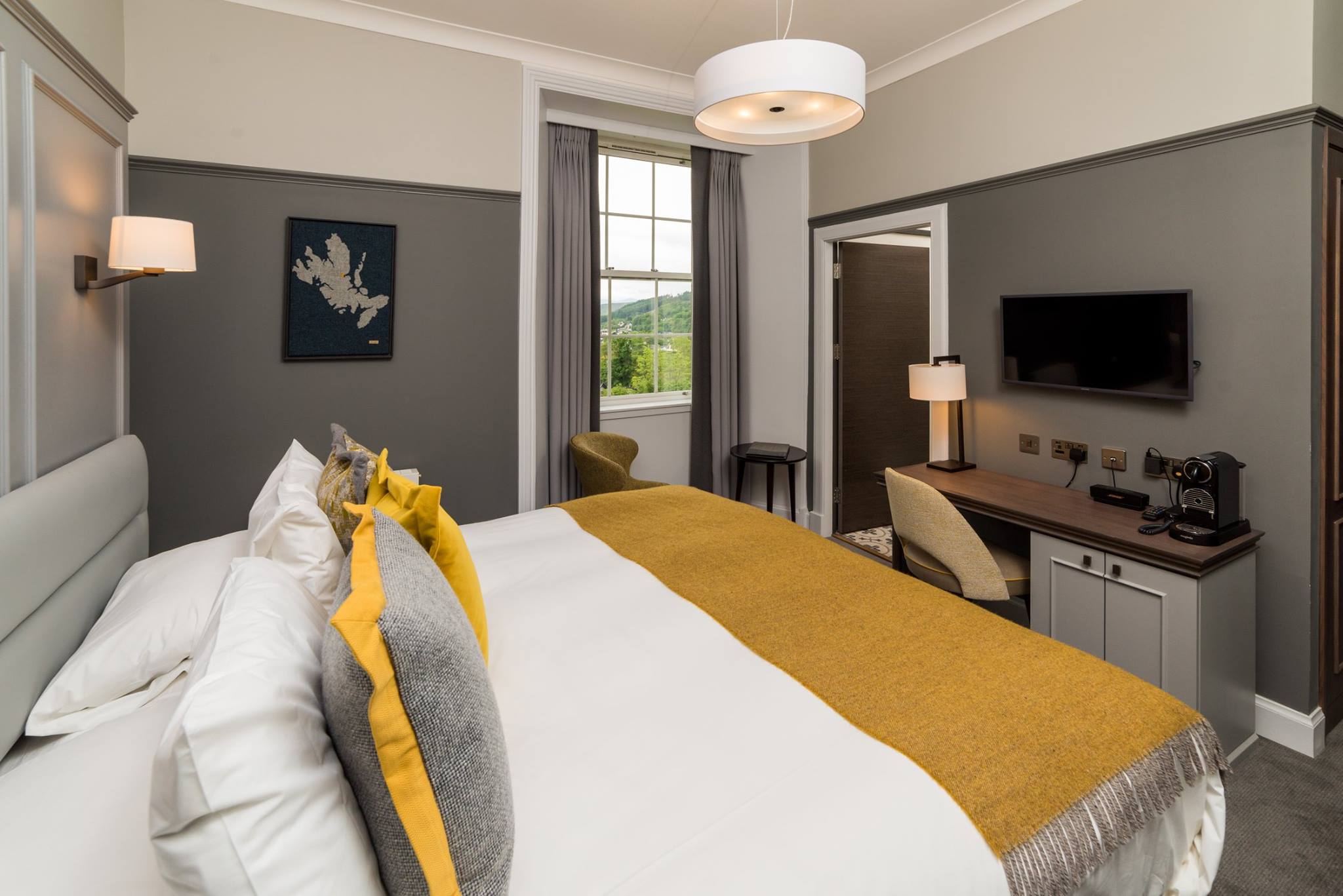
The Marmalade

Perle Hotels Group have a commitment to sourcing interesting, ethical and local work to add character to their properties.

A series of textile island maps for each of the bedrooms in the beautifully renovated Marmalade Hotel, Portree, Isle of Skye.

breaking ground

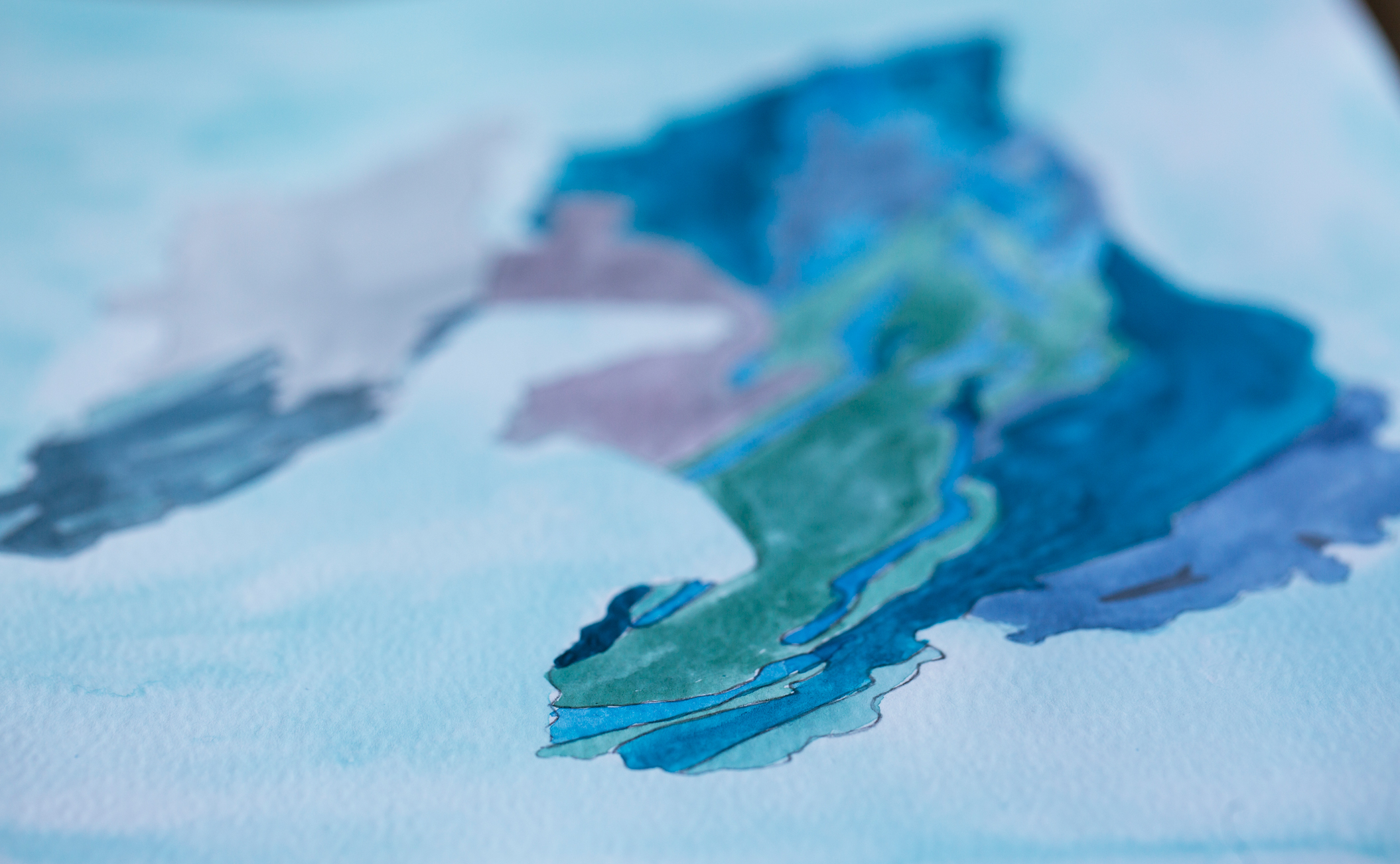
A joint exhibition with painter Julie Arbuckle. Bringing together paintings and textile art through shared inspirations of Scotland’s geology and landscape.

Exhibition Opening

Exhibition Opening

aeolian blue41 x 61cm sewn textiles

aeolian blue

41 x 61cm sewn textiles

loch ard28 x 61cm sewn textiles

loch ard

28 x 61cm sewn textiles

highland boundary blues61 x 61cm sewn textiles

highland boundary blues

61 x 61cm sewn textiles

hutton’s unconformity 25.5 x 41cm sewn textiles

hutton’s unconformity

25.5 x 41cm sewn textiles

goatfell100 x 100cm oil on canvas with hand stitched contours

goatfell

100 x 100cm oil on canvas with hand stitched contours

unconformity, blue20.5 x 61cm sewn textiles

unconformity, blue

20.5 x 61cm sewn textiles

the cloth, the land, the earth II

Solo exhibition at The Watermill Gallery, Aberfeldy 2015.

New works based on the faults and formations that shape the land north of the Highland Boundary Fault.

Inspired by the extensive field work of 19th century geological mapmakers.

Exhibition opening

Exhibition opening

geology, assynt - zone of complication63 x 46cm sewn textiles

geology, assynt - zone of complication

63 x 46cm sewn textiles

section, ben more & moine thrust20 x 42cm sewn textiles

section, ben more & moine thrust

20 x 42cm sewn textiles

contours, black cuillin33.5 x 28.5cm sewn textiles

contours, black cuillin

33.5 x 28.5cm sewn textiles

section, buachaille etive mor and beag15 x 41cm sewn textiles

section, buachaille etive mor and beag

15 x 41cm sewn textiles

northern moine thrust belt31 x 26.5cm sewn textiles

northern moine thrust belt

31 x 26.5cm sewn textiles

section, moine thrust45 x 100cm sewn textiles

section, moine thrust

45 x 100cm sewn textiles

geology, skye - central complex66 x 54.5cm sewn textiles

geology, skye - central complex

66 x 54.5cm sewn textiles

fieldwork at knockan crag, assynt - moine thrust exposure

fieldwork at knockan crag, assynt - moine thrust exposure

stitching the geology of skye

stitching the geology of skye

walking in the black cuillin

walking in the black cuillin

the cloth, the land, the earth

Jane’s first solo exhibition, at The Watermill Gallery Aberfeldy 2013.

Jane-Hunter-Art-Harris-Tweed-Mapwork-Aberfeldy 2.jpg
outer hebrides, machair58 x 42cm sewn textiles

outer hebrides, machair

58 x 42cm sewn textiles

loch rannoch30 x 27cm sewn textiles

loch rannoch

30 x 27cm sewn textiles

bedrock geology, lewis & harris30 x 27cm sewn textiles

bedrock geology, lewis & harris

30 x 27cm sewn textiles

contours, queen’s view47 x 70cm sewn textiles

contours, queen’s view

47 x 70cm sewn textiles

bedrock geology, arran30 x 27cm sewn textiles

bedrock geology, arran

30 x 27cm sewn textiles